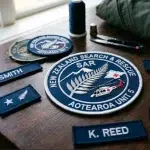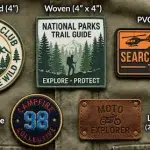
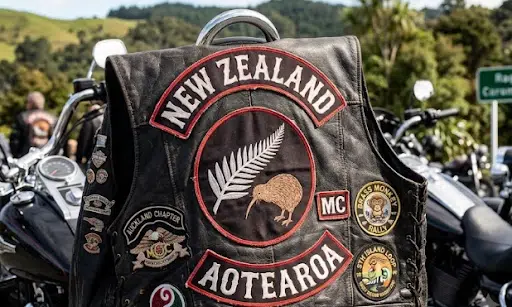
Motorcycle club patches carry a language of their own. For anyone outside the riding world, a jacket covered in embroidered emblems might look like decoration. For the riders who wear them, every patch is a statement of identity, rank, loyalty, and history.
Understanding motorcycle club patch meanings helps newcomers read the culture correctly and helps riders in New Zealand appreciate the craftsmanship and symbolism behind every stitch on a vest.
This guide walks through the structure of club patches, explains widely recognised motorcycle club symbols, and unpacks the history behind Hells Angels symbols, one of the most recognised and most misunderstood patch systems in motorcycling culture.
Along the way we will look at how riding clubs, social groups, and businesses across New Zealand use custom motorcycle patches to build their own identity, safely and legally, through embroidery.
What Are Motorcycle Club Patches?
Motorcycle club patches are embroidered emblems worn on the back, front, and sleeves of a vest or jacket, commonly called a “cut” in riding circles. They originated in the United States after the Second World War, when returning servicemen formed riding clubs and adopted military style insignia to signal membership, rank, and territory.
Over the following decades the tradition spread worldwide, and today motorcycle patches meaning and design vary enormously between social riding clubs, charity groups, veteran associations, and more tightly organised motorcycle clubs.
At their core, these patches serve three purposes. They identify the wearer’s club or group. They communicate rank or role within that group, such as president, road captain, or sergeant at arms.
And they mark milestones, such as years of membership, distance travelled, or events attended. This layered system of biker patch meanings is why a single vest can carry dozens of small emblems alongside the main club insignia.
The Three Piece Patch: How Motorcycle Club Symbols Are Structured
Most established motorcycle clubs use what is known as the three piece patch, a format that has become the standard for motorcycle club patches worldwide.
Top Rocker
The top rocker is the curved patch positioned above the main emblem. It usually displays the club name in bold embroidered lettering. The curved “rocker” shape has become so associated with club structure that many independent riding groups deliberately avoid it, out of respect for established motorcycle club conventions.
Centre Patch
The centre patch is the main emblem, typically featuring the club’s logo, mascot, or symbol. This is the most recognisable part of any set and the piece most riders associate with the club’s identity. Centre patches range from simple lettering to detailed illustrated designs, often produced through dense embroidery or a mix of embroidery and appliqué for extra dimension.
Bottom Rocker
The bottom rocker sits below the centre patch and traditionally displays a location, such as a state, region, or chapter city. In many riding cultures, the bottom rocker is treated with particular significance, as it signals territorial identity and chapter affiliation.
Rank and Position Patches
Smaller patches placed near the centre patch or on the front of the vest often indicate a member’s role, such as president, vice president, treasurer, or road captain. These smaller motorcycle club symbols are earned through time in the club and trusted responsibility, and they are rarely awarded lightly.
Common Motorcycle Club Symbols and What They Represent
Beyond the three piece structure, individual symbols carry their own meanings across motorcycling culture generally.
- Winged wheels or winged emblems commonly represent speed, freedom, and the open road.
- Skulls are widely used across biker culture to represent resilience, rebellion, and facing mortality without fear.
- Eagles and hawks often symbolise freedom, vigilance, and national pride, particularly among veteran riding clubs.
- Number patches, such as a specific numeral or percentage, are used by certain clubs to denote a defined identity within the wider motorcycling community.
- MC patches, a small diamond or rectangle reading “MC,” are used by clubs that identify formally as a motorcycle club rather than a general riding association.
It is worth noting that motorcycle club symbols are not standardised across the entire riding world. Meanings can shift by country, by club, and by era. What matters most to any individual club is the meaning they themselves assign to their own emblem, which is exactly why so many groups in New Zealand choose to design an original patch rather than borrow symbolism from clubs overseas.
Hells Angels Patches Meaning: History and Symbolism
No discussion of motorcycle club patch meanings would be complete without addressing the Hells Angels, one of the oldest and most globally recognised motorcycle clubs, founded in California in 1948.
The Hells Angels’ best known emblem is the winged skull design, often called the “Death Head.” This centre patch typically appears above and below the club’s signature top and bottom rockers, following the same three piece structure used across motorcycling culture. The imagery draws on military aviation insignia from the era in which the club was founded, reflecting the ex-servicemen roots common to many early motorcycle clubs.
The Hells Angels also use the number 81 in some of their Hells Angels symbols, a numerical code referring to the eighth and first letters of the alphabet, H and A. This kind of coded numbering is a recurring device across biker culture more broadly, where numbers, colours, and small details often carry meaning understood mainly within the club itself.
It is important for readers and riders alike to understand that the Hells Angels’ emblems, including the Death Head design, club name, and associated marks, are registered trademarks actively protected by the organisation in multiple countries, including New Zealand.
Reproducing these specific marks without authorisation is a trademark matter, not simply a design choice. For anyone interested in the visual language of biker patch meanings, the Hells Angels provide a useful case study in how symbolism, history, and legal protection intersect within motorcycling culture.
For an original club, the smarter and safer path is always a distinct design built around your own group’s story. Looking to build a patch identity that is entirely your own? Talk to our design team about a custom motorcycle patch and get a proof before you commit to production.
Biker Vest Patches: Placement and Etiquette
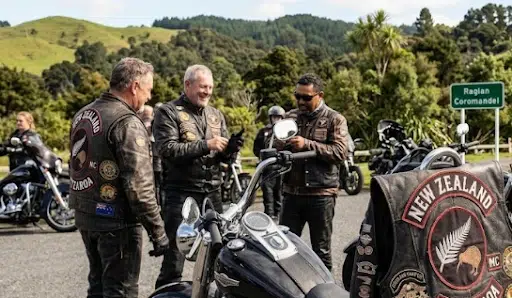
Placement on a vest is not arbitrary. Traditional biker vest patches follow informal but widely respected rules.
- The back of the vest is reserved for the largest and most significant patches, typically the full three piece set for club members, or a single large emblem for social riders.
- The left chest, over the heart, often carries a name patch or a smaller club identifier.
- The right chest is commonly used for a nickname, role title, or a smaller emblem tied to a personal achievement.
- Sleeve and front panel patches are frequently used for event badges, memorial patches, or affiliations with other clubs and causes.
For riders assembling a vest from scratch, thinking through placement early avoids a cluttered result later. A well organised set of motorcycle vest patches should tell a clear story at a glance, from club identity through to personal milestones.
Custom Motorcycle Patches: Why Riders Choose Embroidered Options
Embroidered patch remains the material of choice for custom motorcycle patches because it is durable, weather resistant, and holds fine detail well over years of wear. Unlike printed or heat transferred designs, embroidered thread does not crack, peel, or fade in direct sunlight, which matters enormously for a patch that may sit on a leather or denim vest for a decade or more.
Riding clubs, social groups, workplace crews, and event organisers across New Zealand commission custom biker patches for reasons that go well beyond aesthetics.
- Club identity. A distinct centre patch, rocker, and colour scheme give a new or growing club a recognisable presence at rallies and rides.
- Milestone recognition. Anniversary patches, distance patches, and event badges reward members and mark shared history.
- Merchandise and fundraising. Charity rides and community groups often sell branded patches as a simple, low cost way to raise funds.
- Corporate and hospitality use. Motorcycle themed cafes, gear shops, and tourism operators use custom patches as a point of difference for staff uniforms and retail merchandise.
Because embroidered motorcycle patches are built stitch by stitch to a digitised file, clubs retain full control over colour, size, backing type, and border style, making every set genuinely unique. For the ultra premium finish, motorcycle emblems can be made with leather patches as well.
How to Order Custom Biker Patches from Embroidery Patch NZ
Ordering custom patches need not to be complicated. At Embroidery Patch NZ, the process is built around getting your design right before a single stitch is sewn.
- Share your logo, sketch, or concept, even a rough description is enough to start.
- Our design team digitises the artwork and sends a free proof for approval.
- Choose your backing type, iron on, sew on, or the flexible Velcro (hook-and-loop), along with size and border finish.
- Approve the final proof and place your order, with bulk pricing available for clubs ordering in volume.
Whether you need a single sample patch or a bulk run for an entire chapter, our team works directly with clubs, riding groups, and businesses across New Zealand to keep turnaround times fast and quality consistent.
Why Choose Embroidery Patch NZ for Your Club’s Patches
New Zealand riders have several options when sourcing custom patches, from overseas bulk manufacturers to local embroidery studios. Overseas suppliers can offer low unit costs but often come with long shipping times, limited proofing, and communication gaps across time zones.
Embroidery Patch NZ offers premium custom patches in New zealand with a middle path many clubs prefer: local turnaround, direct proof approval before production, and pricing structured for both small social clubs and larger multi chapter orders.
For a club patch that represents years of identity and history, working with a supplier who gets the details right the first time matters more than shaving a few dollars off the unit price.
Frequently Asked Questions
What do the different patches on a motorcycle vest mean?
Motorcycle vest patches signify club membership, rank, and achievements. A three-piece set indicates club identity, while smaller patches denote roles and events. Placement and design together convey substantial meaning about the wearer’s affiliation and experiences.
What does the number 1 percent patch mean in biker culture?
The one percent patch, a diamond-shaped emblem, signifies a subset of motorcyclists outside mainstream associations, originating from a comment on law-abiding riders, though meanings can vary by club context and history.
Can anyone buy or wear Hells Angels patches?
Hells Angels’ emblems, like the winged skull, are registered trademarks in New Zealand and globally, requiring authorization for reproduction. Membership patches represent commitment and should be original designs.
How much does a custom embroidered motorcycle patch cost in New Zealand?
Pricing for custom embroidered motorcycle patches in New Zealand varies by size, stitch density, colours, and quantity, with bulk orders lowering costs. Various backing types influence pricing, and Embroidery Patch NZ offers clear quotes and free proofs.
Order Your Motorcycle Club Patches Today
Motorcycle club patches are far more than decoration. They are a structured visual language built from top rockers, centre patches, bottom rockers, and rank badges, each carrying meaning earned through time and loyalty within a club.
Understanding Hells Angels symbols and other well known emblems offers insight into how this tradition developed, while respecting that established clubs’ specific marks remain their own protected identity.
For riders, social clubs, and businesses across New Zealand looking to build a patch identity of their own, embroidery remains the most durable and detailed way to bring a design to life.
If your club is ready to move from concept to finished patch, our team is ready to help. Start your custom patch design with Embroidery Patch NZ today and get a free quote today.