Why Businesses and Teams in NZ Invest in Custom Uniform Patches
The importance of uniforms extends beyond what many owners think about them. The message is delivered long before people start talking, whether it’s a crew arriving at a work site, a service team on duty, or a sports club stepping onto the field.
Custom uniform patches are one of the easiest ways to sharpen that message and turn a generic jacket or polo shirt into something that means more to both customers and employees.
An unbranded uniform is simply clothing. For tradies, hospitality workers, security personnel and sports teams across New Zealand, a patch changes that.
It gives a business a consistent look that doesn’t depend on which base garment a worker happens to be wearing that day. It makes employees recognisable, both for customer-facing roles and for trade or security purposes. It’s also far more durable than printed branding and holds up better over repeated washing and outdoor wear.
Because patches can be attached with Velcro, iron-on backing or by sewing, a business doesn’t need to keep restocking an entire uniform run every time it updates its clothing. This matters most for growing businesses. A patch bought once with a hook-and-loop backing can move from an older uniform to a new one, so staff changes and uniform updates don’t mean starting from scratch.
This guide walks through everything you need to know before ordering: patch types, backings, sizing, artwork, pricing, and how to choose a supplier.
Which Custom Patch Should You Choose? (Quick Reference)
| If you need… | Best starting point |
| Traditional corporate or workwear appearance | Embroidered |
| Small text or fine logo detail | Woven |
| Wet, muddy or outdoor environments | PVC |
| Frequently changing employee names | Velcro-backed name patches |
| Maximum permanence | Sew-on |
| Easy removal or replacement | Hook-and-loop (Velcro) |
The sections below go into each of these in more detail so you can make a confident decision, not just a guess.
Types of Custom Patches for Workwear and Team Uniforms
The types of custom patches in NZ are numerous, and hence not every patch is built the same way. The right style depends on the garment, the environment, and the look a business wants.
Not every patch is built the same way. The right style depends on the garment, the environment it’s worn in, and the look a business wants.
Embroidered Patches
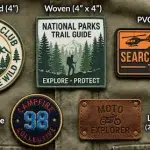
Embroidered patches are a textured, dimensional design created with raised, stitched thread. They suit logos with distinct shapes and a reasonable amount of detail, and they’re a popular choice for NZ workwear because of the traditional, professional finish they give.
Durability depends on more than the patch type alone. Thread quality, stitch density, colourfastness, and how the garment is laundered all affect how long a patch holds its colour and shape. For patches that will get regular sun exposure, ask your supplier about colourfast or UV-resistant thread rather than assuming any embroidered patch will hold up the same way.
Woven Patches
Woven patches use a finer thread weave than standard embroidery. This makes them a better fit for logos with small lettering or fine detail. Woven patches also lie flatter on the garment than a fully embroidered logo, which is why they’re often preferred on shirts and polo tops.
PVC Patches
PVC patches are made from soft rubber rather than stitched thread, giving a three-dimensional look and sharp colour contrast. They’re waterproof by nature and handle moisture and mud well, which makes them a solid choice for outdoor work, security roles, or hospitality environments where patches take a beating.
Embroidered vs Woven vs PVC
| Embroidered | Woven | PVC | |
| Best for | Traditional, textured logos | Small text, fine detail | Wet, outdoor, high-wear environments |
| Finish | Raised, dimensional | Flat, fine detail | 3D, glossy, bold colour |
| Weather resistance | Good with the right thread | Good | Excellent (waterproof) |
| Typical use | Corporate uniforms, jackets | Shirts, polos, caps | Security, outdoor trades, hospitality |
Choosing the Right Patch Backing
The attachment method matters as much as the patch type itself.
- Sew-on is the strongest form of attachment and generally the best choice for uniforms that go through regular commercial laundering or heavy daily wear.
- Iron-on is convenient to apply and works well where the fabric and care routine suit it, but the adhesive can weaken over time, particularly with frequent washing or high-heat drying. Treat it as a convenient option rather than the most permanent one.
- Velcro (hook-and-loop) offers the most flexibility. Patches can move between uniforms or employees, which is especially useful for name patches or for businesses expecting staff turnover.
| Backing | Best for | Main advantage | Main drawback |
| Sew-on | Heavy-duty, frequently laundered workwear | Strongest attachment | Not easily removable |
| Iron-on | Suitable, lower-wash garments | Easy application | Adhesive can weaken over time |
| Velcro | Changeable branding, name patches | Reusable and removable | Needs a compatible hook-and-loop surface on the garment |
Backing choice isn’t independent of the garment. Cotton, polyester, blends, nylon and waterproof outdoor fabrics all respond differently to heat and adhesive. If a garment can’t tolerate the heat needed for iron-on application, sew-on or Velcro is the safer route. Your supplier should be able to tell you which backing suits your specific fabric, not just your preference.
Name Patches for Employees
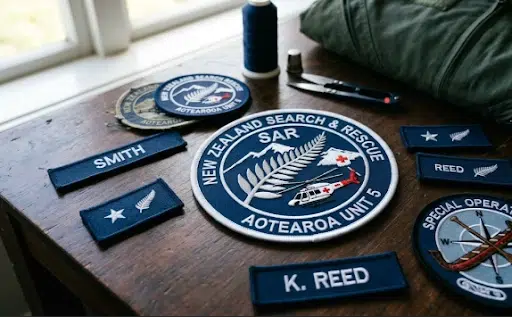
Name patches add a layer of personalisation beyond branding. First names, titles, or both give customers someone to address and give employees a small sense of ownership over their role.
They’re especially common in hospitality, retail, healthcare and trade businesses where staff deal directly with the public. Most companies order name patches in a consistent font, colour and background, then individualise each one per employee. Velcro backing suits this well, since the same patch style can be reused when a new employee starts.
ALT Text: Custom logo patch for uniform with name tag and organisation branding.
Business Logo Patches
Business logo patches are usually the main feature of a uniform, placed on the chest, sleeve, or cap front for maximum visibility. Beyond styling the uniform, a well-placed logo patch promotes the brand every time a staff member is out in public or on the job.
When ordering a logo patch, it helps to simplify the design to as few shapes and colours as possible, generally no more than three or four. Gradients and very small text don’t translate well into embroidery, and a good supplier will usually flag this at the artwork stage rather than after production.
What Size Should a Uniform Patch Be?
Patch size depends heavily on the logo itself and where it’s going, not just a fixed standard. As a general guide:
- Name patches: typically 2 to 3 inches wide
- Chest logos: commonly 3 to 4 inches, depending on detail
- Sleeve patches: usually smaller, 2 to 3 inches
- Cap patches: simplified logos, generally under 3 inches
- Back patches: 4 inches or larger, since they need to be visible from a distance
Text-heavy designs usually need a larger patch than a simple icon or logomark, because letters need enough width to stay legible once stitched. Aspect ratio matters too — a wide, low logo won’t scale the same way as a square or circular one.
Where to Place a Patch
- Chest: best for the primary business logo
- Sleeve: good for secondary branding, role identifiers, or team/division names
- Name patch: usually opposite the primary logo, depending on uniform layout
- Cap: works well for simplified logos only
- Back: suited to larger branding, but needs more garment space and a larger patch
Before finalising placement, check it against pockets, seams, zips and any other garment construction that might interfere.
Logo and Artwork Requirements
Vector artwork (AI, EPS, SVG or PDF) gives the cleanest result, but a high-resolution PNG or JPEG will usually work too. If you don’t have existing artwork, most suppliers can create a sample from a rough sketch or photo.
A few things worth knowing before you send artwork over:
- Very fine lines and small text may need to be simplified or enlarged to stitch cleanly
- Gradients don’t embroider well and are usually converted to solid colours
- Colour count affects both cost and clarity, fewer colours generally reads better at small sizes
- Your supplier may suggest small modifications to your logo purely so it holds up in patch form, this is normal and worth listening to
How to Order Custom Patches: Step by Step
- Send your artwork. Vector format is ideal; high-quality PNG or JPEG works in most cases.
- Choose your patch type. Embroidered, woven or PVC, based on detail level and where the uniform will be worn.
- Choose your size and backing. Match the backing to how often the patch needs to move and what the garment fabric can handle.
- Approve a digital proof. A reliable supplier sends this before production starts.
- Confirm quantity and timeline. Order for your current headcount plus a buffer for future hires.
- Production and delivery.
Before You Approve the Proof, Check
- Spelling (especially on name patches — a single error means an unusable patch)
- Employee names and titles
- Logo proportions and overall patch dimensions
- Thread and border colours
- Backing type
- Placement
- Quantity
- Delivery address and deadline
How Much Do Custom Uniform Patches Cost in NZ?
Pricing depends on several factors together, not any single one:
- Patch dimensions
- Stitch coverage and density
- Number of colours
- Patch type (embroidered, woven, PVC)
- Border finish
- Backing type
- Order quantity
- Individual name changes
- Artwork or digitisation work
- Rush production or expedited shipping
As a general example, a 3-inch embroidered patch with full coverage runs around $14.86 each at 10 units, dropping to about $2.23 each at 100 units, with further savings at higher quantities. Smaller orders carry a higher per-unit cost; pricing improves as quantity increases. There’s no minimum order, so this scales down comfortably for small teams too. For an exact number, check our current pricing or request a quote based on your specific size, colours and quantity.
How Many Should You Order?
Order for your current headcount, plus a reasonable buffer for future hires and replacements for lost or damaged patches. If you’re using Velcro backing, you may need fewer spares since patches can be moved between uniforms.
How Long Does Production Take?
Most orders are completed within 1 to 2 weeks after artwork approval, depending on order size and patch type. If patches are needed for a specific rollout date or event, confirm the full timeline, including shipping, before you order.
Caring for Your Uniform Patches
Sew-on and iron-on patches generally hold up well under normal washing routines. Turning garments inside out before washing helps protect both the stitching and the colour.
Avoid high-temperature tumble drying where possible. Constant heat exposure can weaken iron-on adhesive over time, which is one of the more common reasons patches eventually come loose.
Velcro-backed patches should be removed before washing. Learn how to care for Velcro patches properly, this protects the patch itself and keeps the hook-and-loop surface on the garment working.
Care also depends on the garment’s own fabric and its care label, not just the patch. Always follow the garment manufacturer’s care instructions alongside your supplier’s advice for the patch type you’ve chosen. If the two ever conflict, the garment’s care label is usually the limiting factor.
How to Choose a Custom Patch Supplier in NZ
A good supplier is the difference between patches that last the life of a uniform and ones that fray within a season. Worth checking before you commit:
- Can they show you actual finished examples of past work?
- Do they explain artwork limitations upfront rather than after production?
- Can they recommend the right backing for your specific fabric?
- Is there a digital proofing step before production?
- Are minimum order quantities clearly stated?
- Are shipping costs and timelines clear?
- Is GST included or excluded in their pricing?
- What happens if delivered patches don’t match the approved proof?
- Do they offer samples before you commit to a full order?
Frequently Asked Questions
How much do custom uniform patches cost in NZ?
Cost depends on patch size, stitch density, number of colours, backing and order quantity. Smaller orders cost more per unit; bulk orders bring the price down.
What’s the difference between embroidered and woven patches?
Embroidered patches use thicker, raised thread and suit bold, simpler logos. Woven patches use finer thread and handle small text and detail better. Both hold up well on workwear when made with quality thread.
Are embroidered or woven patches better for small text?
Woven, generally. The finer thread weave reproduces small lettering more clearly than standard embroidery.
What backing is best for workwear?
Sew-on for uniforms that are laundered frequently or worn hard. Iron-on works for lighter use. Velcro suits businesses that need to move patches between uniforms or staff.
Can I order a small batch of custom patches?
Yes. There’s no minimum order quantity, so small teams and individual orders are welcome alongside bulk orders.
How long does it take to receive custom uniform patches after ordering?
Most orders are completed within 1 to 2 weeks after artwork approval. Rush production may be available for tighter deadlines, so confirm timing with your supplier if you’re working to a specific date.
What artwork file should I send?
Vector formats (AI, EPS, SVG, PDF) give the cleanest result. A high-resolution PNG or JPEG usually works too.
Can you make individual employee name patches?
Yes. Most businesses order a consistent style and colour scheme, then personalise each patch with an individual name.
Can patches be used on waterproof jackets?
PVC patches are the best fit for waterproof or heavy outdoor garments, since they’re waterproof themselves and don’t rely on stitching that could compromise the jacket’s seal.
Are PVC patches suitable for outdoor work?
Yes. Their waterproof, mud- and moisture-resistant construction makes them a strong choice for security, trade and outdoor hospitality roles.
Get a Free Quote for Your Custom Uniform Patches
Custom uniform patches are a straightforward way for NZ businesses to look more professional with branding that actually holds up. Whether that’s embroidered patches, PVC, name tags or logo patches, the right style, backing and supplier make the difference in how long they last.
We can provide free samples and help with design for your staff or club uniforms.