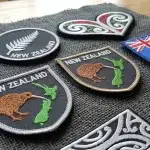
Velcro patches are the gold standard for tactical gear and team kits. If you don’t look after the hook-and-loop backing, your expensive branding ends up in the mud. Hook and loop technology uses two fabric surfaces, a stiff “hook” side with tiny plastic hooks and a soft “loop” side with woven fabric loops. That interlock under pressure to create a repositionable, load-bearing bond.
Custom velcro patches give New Zealand outdoor crews, sports teams, military personnel, and workwear brands the ability to swap patches between garments in seconds. That flexibility comes with a maintenance requirement.
This guide covers every attachment, cleaning, and troubleshooting step to keep custom patches NZ gear performing at full grip strength through every season.
The Proper Attachment: Alignment is Everything
Align the patch edges perfectly with the female loop side on your jacket. Overhanging edges catch on backpack straps and pull the patch loose over time.
Precise alignment is not a cosmetic concern. It is a structural one. A patch positioned with even 3mm of overhang on one edge creates a lever point, every time fabric, a strap, or a branch catches that overhanging edge, it applies a peeling force to the hook-and-loop bond. Over repeated catches, the overhang lifts progressively until the full patch detaches.
The attachment sequence for a clean, secure bond:
- Step one: Position the loop panel on the garment first. The loop side, the soft, fabric-textured side, goes on the garment permanently.
- Step two: Press the loop panel flat against the garment surface. Run your thumb firmly across the full surface in overlapping passes to eliminate air bubbles and ensure full contact between the loop backing and the garment fabric.
- Step three: Hold the patch hook-side down directly above the loop panel. Lower straight down rather than sliding into position. Sliding the hook side across the loop surface before full engagement misaligns the fibres and reduces initial grip strength.
- Step four: Press firmly across the full patch surface with the heel of the hand. Apply 10 to 15 seconds of sustained downward pressure. Hook-and-loop engagement strength increases with the completeness of hook penetration into the loop pile, a firm, sustained press drives the hooks fully into the loops rather than sitting on the surface.
Cleaning the “Grit”: Protecting the NZ Tramping Kit
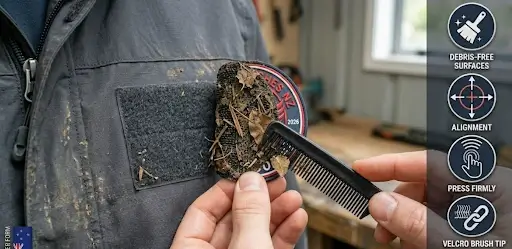
The New Zealand bush delivers a specific combination of debris that destroys Velcro grip faster than any other environment. Mud from the Tongariro Crossing clogs the hook fibres solid. Gorse spines snap off inside the loop pile and prevent engagement.
None of this debris falls out on its own. It packs into the hook and loop fibres and stays there until someone removes it manually.
- The fine-tooth comb method is the most effective field restoration technique for hook-side debris.
- The dedicated Velcro brush a stiff-bristle brush sold specifically for hook-and-loop maintenance works faster than a comb on heavily contaminated surfaces.
- The loop side requires a different approach. The loop pile mats flat under compression and debris. Use a soft-bristle brush in light circular motions to lift the loop pile back to standing height.
- Field cleaning without tools a strip of fresh hook-side Velcro pressed firmly onto a contaminated loop surface and peeled away quickly acts as a debris lifter.
For custom patches NZ gear returning from a multi-day tramp, a full clean before storage prevents debris from compacting further and becoming harder to remove. Five minutes with a comb and a soft brush at the end of a trip saves the grip strength of the Velcro base for the next outing.
Why PVC and Velcro Are the “Power Couple” of Branding
Every material combination in patch production has a logic. PVC backed with Velcro is the combination that makes the most sense for the widest range of New Zealand applications — and the reason comes down to two properties that work together: cleanability and repositionability.
Custom PVC patches use a moulded plastic surface that sheds mud, water, and debris with a brush or a rinse. The pigment lives inside the PVC compound rather than on a fabric surface, so cleaning the patch face never risks colour damage.
Troubleshooting: When the “Stick” Starts to Slip
Grip loss on a Velcro patch has three causes. Identify the right one before replacing the patch or the base.
- Debris contamination is the most common cause and the easiest fix. A contaminated hook surface grips at 30% to 50% of its clean capacity. The patch feels loose without being structurally damaged. Clean both hook and loop surfaces using the comb and brush method described above.
- Thread fraying on the loop side reduces the grip surface area permanently. Individual loop fibres break through repeated engagement cycles, hot washing, or abrasion from open-hook contact.
- Heat warping of the hook side deforms the plastic hook fibres permanently. Warped hooks lose their curved profile and can no longer catch loop fibres effectively.
- PSA base failure occurs when the adhesive backing on a pressure-sensitive loop panel loses bond strength. The loop panel begins to peel from the garment surface, taking the engaged patch with it.
- Oversized patch on undersized loop panel creates a leverage imbalance. The patch extends beyond the engagement zone and the unsupported edge acts as a peel point. Replace the loop panel with one that matches the full patch dimensions including a 2mm border on all sides.
FAQ
Are Velcro patches waterproof?
The hook and loop fastening system itself is water-resistant, nylon hook and loop fibres do not absorb water or lose structural integrity when wet. Grip strength reduces slightly when both surfaces are saturated.
Can I iron Velcro onto a garment?
PSA-backed Velcro loop panels apply with iron heat in the same way as iron-on patches 160°C for 20 seconds on cotton and poly-cotton. Do not iron directly over hook-side Velcro. The heat deforms the plastic hook fibres permanently.
Can I add Velcro to a standard patch that doesn’t have it?
Yes. A hook-side Velcro panel bonds to the back of any existing patch using fabric adhesive or contact cement. Clean the patch back surface with isopropyl alcohol first. Apply a thin, even layer of contact cement to both the patch back and the Velcro hook panel.
How long does Velcro backing last?
Quality nylon hook-and-loop backing handles 10,000 to 20,000 engagement cycles before grip strength degrades noticeably. In daily practical use on outdoor and workwear garments, a well-maintained Velcro base lasts 3 to 5 years.
Ready to Upgrade Your Kit with Embroidery Patches NZ?
One custom PVC patch with Velcro backing moves between jackets, vests, packs, and helmets in under three seconds. It survives the Tongariro, the Routeburn, the worksite, and the wash cycle. It cleans in 60 seconds and engages at full grip strength every single time.
Embroidery Patches NZ produces custom Velcro patches for outdoor crews, sports teams, tactical units, workwear brands, and anyone who needs a patch that actually stays on the gear. Select the Velcro backing option on the order page, upload the design, and the rest is production.