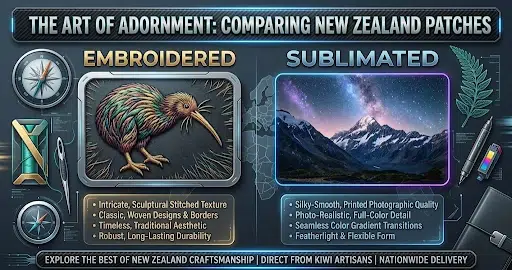
It sounds like a minor detail. This one choice decides three things, how your patch looks, how it feels when you run your thumb over it, and whether it’s still in good nick five years from now or looking tired after a handful of washes?
Walk around any New Zealand club or workplace and you’ll spot both. Rugby jerseys and netball warm-ups carry stitched club crests.
Cafes put a little embroidered flair on their staff aprons. The techniques get used interchangeably a lot of the time, but they really shouldn’t be, a design that suits one can fall flat with the other.
We’ll go through what actually separates embroidered from sublimated patches, the materials, how each is made, where one beats the other, and the mistakes we see buyers make over and over.
Embroidered Patches: The Thread Texture Approach
Custom embroidered patches are the original choice for adding a unique and personalised aspect to your attires. You’d pick one out of a lineup without even trying, that raised, slightly bumpy surface built up from hundreds, sometimes thousands, of individual stitches.
Think of your old school blazer badge, the emblem on your dad’s fishing club vest, or the patch stitched onto a security guard’s uniform. That’s embroidery and if texture is what you’re chasing for your own design, this is the technique that delivers it.
Along the way we’ll pull in some real examples from New Zealand suppliers like Embroidery Patch NZ, since it helps to know what’s actually on offer locally before you start designing.
How embroidered patches are made
It all starts with a digitised file, a roadmap. From there, the machine gets to work, laying down coloured thread onto a base fabric (twill, most of the time) one layer on top of another, until what was a flat design slowly turns into something you can actually feel with your fingers.
Once the stitching’s done, the patch gets cut to shape. Most go with a merrowed, overlocked border for that traditional raised edge, though some suppliers offer laser-cut borders instead, if you’re after something sharper and more streamlined.
Specifications worth knowing
- Thread type: Usually polyester or rayon thread, chosen for colourfastness and durability in NZ’s harsher UV conditions.
- Base fabric: Twill is the industry standard because it holds stitches firmly and doesn’t fray easily.
- Coverage: Can range from 50% thread coverage (with visible background fabric) up to 100% “full coverage” for a denser, richer look.
- Backing options: Iron-on, sew-on, Velcro hook and loop, peel-and-stick, pin, button loop, and even magnetic, all these options are offered in this full range.
- Border finish: Merrowed borders for a traditional raised edge, or heat-cut/laser-cut borders for sharper, more intricate outlines.
Where embroidered patches work best?
- Club and uniform badges with bold, simple logos and limited colours
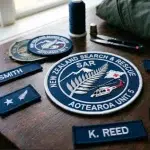
- Name tags and rank or position badges
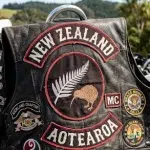
- Motorcycle and biker patches wanting that rugged, textured look
- Corporate uniforms where durability matters more than fine detail
- Merch with retro or heritage appeal, since the raised stitch reads as “quality” at a glance
Tips for getting embroidered patches right
- Simplify your design before sending it off. The fine text under about 5mm tall often turns into a blob of thread rather than legible letters
- Stick to solid colour blocks instead of gradients, thread just can’t blend colours the way ink does.
- Ask for a digital mockup first, so you can catch stitch direction or colour issues before production
- If your logo has a lot of small detail, consider simplifying it specifically for the patch version rather than using your full-resolution logo
- Choose thread colours from the supplier’s actual thread chart, not just a screen colour, because monitors and thread can render shades differently
Sublimated Patches: The Photo Detail Approach
Sublimation’s a totally different process. No thread is involved at all and the design gets printed onto polyester using heat, which turns the dye into a gas and pushes it right into the fabric itself.
That’s why the finish comes out dead flat and smooth and it’s also why sublimation can pull off things embroidery never could, full-colour photos, gradients, shading, all the fiddly bits. Basically, if your design’s got a lot going on, this is the technique built for it.
How sublimated patches are made
Your design goes onto a special transfer paper first, using sublimation ink, then it’s pressed onto polyester with a heat press. The heat does the real work, it turns the ink into a gas, and that gas pushes straight into the fibres instead of just sitting on the surface like normal printing would.
The dye’s actually part of the fabric now, not layered on top of it, you don’t get that cracking or peeling or fading you’d see with a cheaper print job.
Embroidery Patch New Zealand does a hybrid version where sublimation printing gets paired with an embroidered border, so you get the sharp detail and a bit of stitched texture on the same patch.
Specifications worth knowing
- Base fabric: Almost always polyester, since the sublimation process needs synthetic fibres to bond the dye properly
- Finish: Completely flat and smooth, lightweight compared to embroidery
- Colour range: Practically unlimited — full-colour gradients, photographic detail, and fine shading are all achievable
- Border options: No backing, merrowed, heat-cut, or laser-cut edges, plus backing choices like iron-on, adhesive, plastic support, Velcro (hook, loop, or double), or safety pin
- Durability: Because the dye is embedded rather than layered on top, sublimated patches resist cracking and peeling better than standard prints
Where sublimated patches work best?
- Detailed logos with gradients, shadows, or multiple fine colours
- Cramming in fine detail or tiny text is a common mistake, once it’s stitched, thread can’t hold that kind of precision, and the design just turns to mush.
- Give that final mockup a proper check for spelling, colours, and sizing before signing off.
- Sports team patches with sponsor logos requiring sharp detail
- Branding that needs to match an exact Pantone or brand colour precisely
Tips for getting sublimated patches right
- Send us your artwork in as high a resolution as it makes a real difference in how crisp the final patch turns out to be (300 DPI or better).
- Avoid extremely small text within complex artwork, as it can lose crispness at small patch sizes
- If durability against heavy abrasion is your top priority, ask your supplier about a sublimation-on-embroidery hybrid for extra structure
- Choose polyester-friendly application methods, since custom sublimated patches are heat-sensitive and shouldn’t be ironed at excessively high temperatures once finished
- Confirm colour proofs before bulk production, since screen colours and printed colours can shift slightly
Thread Texture vs Photo Detail: A Side-by-Side Comparison
| Feature | Embroidered Patches | Sublimated Patches |
| Texture | Raised, textured thread finish | Flat, smooth surface |
| Detail level | Best for bold logos and simple text | Best for photo-realistic and gradient artwork |
| Colour range | Limited to available thread shades | Virtually unlimited, full-colour printing |
| Base material | Twill fabric | Polyester fabric |
| Durability | Extremely hard-wearing, resists fraying with quality thread | Resists cracking/peeling since dye is embedded in fibres |
| Weight/feel | Slightly heavier, more traditional feel | Lightweight, modern feel |
| Typical uses | Uniforms, clubs, name badges, heritage brands | Sports merch, fan gear, detailed logos, photo designs |
| Best border finish | Merrowed border | Merrowed, heat-cut, or laser-cut |
Where Texture Wins? Where Detail Wins? : Applications
Uniforms, clubs, and corporate wear
For most Kiwi workplaces and sports clubs, how to make custom embroidered patches is still the default choice, and it’s not hard to see why. It holds up through wash after wash without losing its shape, which matters when you’re talking about uniforms people wear every single day.
Plus there’s a raised texture, it just looks and feels more established, which is probably why schools, emergency services, and older clubs tend to stick with it.
- Choose embroidered for anything going through regular commercial laundering
- Stick with 2–4 colours for the cleanest stitched result
- Go with a sew-on or iron-on backing for permanent uniform attachment
Merch, events, and fan gear
Sublimated patches suit brands and events wanting a bold, eye-catching visual that photographs well on social media.
Music festivals, gaming communities, and pop-culture brands lean towards sublimation because it lets them reproduce artwork exactly as designed, gradients and all.
- Choose sublimated patches when your artwork includes photography, shading, or gradients
- Use Velcro backing for merch that customers will want to swap between jackets or bags
- Keep an eye on final patch size versus detail level; very small sublimated patches can still lose crispness in tiny text
Motorcycle, military, and heritage-style patches
Both techniques are implemented here, but for different reasons. Embroidery gives that classic, tactile biker-jacket look Kiwi riders often want. This is where it stands out to buy premium custom patches in New Zealand.
Sublimation is used when a design includes intricate insignia, camouflage-style patterns, or fine gradients that thread just can’t replicate cleanly.
- For heritage or biker aesthetics, embroidered is usually the stronger choice
- For detailed camo, gradient, or photographic military-style artwork, sublimated wins out
- Ask about a hybrid sublimation-on-embroidery patch if you want the visual detail of sublimation with a stitched border for extra durability
Cost, Turnaround, and Minimum Orders in New Zealand
One thing that often surprises first-time patch buyers is that pricing between the two methods can be pretty similar. At Embroidery Patch NZ, for example, both embroidered and sublimated patches start from $0.89, with no strict industrial minimums.
Turnaround typically sits around 7–10 business days for standard production in New Zealand, with urgent options available if you’re up against an event date.
Embroidery Patches New Zealand provides a free digital mockup before anything goes into production, so you can check stitch layout or colour accuracy without any financial risk.
A few pointers on ordering smart:
- Ask for a physical sample if you’re ordering in bulk for the first time, not just a digital proof
- If you’re ordering for multiple uniform sizes or garment types, confirm the patch size works proportionally across all of them
- Double-check the spelling, colours, and sizing on that final mockup before you give the go-ahead. Fixing things after production takes more time and money.
Common Mistakes to Avoid
Even with a clear brief, patches can go sideways if a few details get missed early on. Here’s a checklist for first-time buyers:
- Sending low-resolution artwork for a sublimated patch, which results in blurry or pixelated printing
- Packing an embroidered design with fine detail or tiny text — thread just can’t render that stuff cleanly.
- Choosing the wrong backing for the intended use, Velcro on a permanent uniform patch, or sew-on for something meant to be swapped often
- Skipping the mockup stage and going straight to bulk production, which risks costly reprints
- Ignoring garment type, for example, heavier jackets can handle a thicker embroidered patch, while lightweight activewear often suits the slimmer sublimated finish better
- Not checking colour accuracy against a supplier’s actual thread or print chart rather than trusting your screen
Frequently Asked Questions
What’s the main difference between embroidered vs sublimated patches?
Embroidered patches use stitched thread for a raised, textured finish, while sublimated patches use dye-printing for a flat, photo-detailed surface.
Are embroidered or sublimated patches more durable?
Both hold up well long-term, but embroidered patches generally resist abrasion better, while sublimated patches resist cracking and fading.
Can sublimated patches replicate photographs accurately?
Yes, high-quality sublimation can reproduce photo-realistic detail and gradients that embroidery cannot achieve.
What backing options are available for custom patches in NZ?
Common choices include iron-on, sew-on, Velcro (hook and loop), adhesive, pin, button loop, and magnetic backing.
Can I combine embroidery and sublimation on one patch?
Yes, a hybrid option prints the design in full colour and stitches around the edges or key details for added texture and durability.
What’s the typical turnaround time for custom patches in New Zealand?
Standard orders usually take 7–10 business days here at Embroidery Patches New Zealand.
Thread Texture or Photo Detail, Which Wins for You?
Got a simple logo, wordmark, or emblem? Go with embroidery. That raised, stitched texture just has a quality feel to it, think classic varsity patches or brand badges.
But if your design has fine details, gradients, or anything photo-like, embroidery will lose those subtleties in the stitching. Sublimation is what you want there, it prints the dye directly into the fabric, so it can capture all that detail without the limitations thread has.
Plenty of Kiwi brands and clubs actually end up using both across different products, embroidered for uniforms and jackets, sublimated for event merch or detailed sponsor logos.
Just reach Embroidery Patches NZ for your chosen patch styles and design.. It costs nothing and it can save you from a reprint bill down the track.