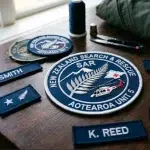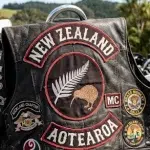
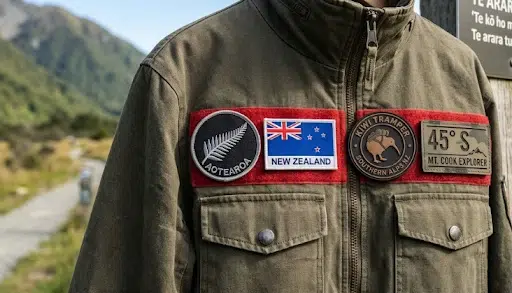
Velcro patches, also called hook-and-loop patches, are embroidered, PVC, or woven patches with a hook-and-loop fastening system on the back. The “hook” side (rough, scratchy) attaches to a “loop” panel (soft, fabric-like) sewn or ironed onto your garment, bag, or gear.
This lets you swap, reposition, or remove the patch in seconds without any tools or damage to the fabric. They are the go-to backing for military uniforms, tactical gear, sports kits, workwear, motorcycle jackets, and anywhere a removable, reusable patch is needed.
What Are Velcro Patches?
Velcro patches are custom patches: embroidered, PVC, woven, or leather. They carry a hook-and-loop fastening system on their reverse side instead of, or in addition to, a standard sew-on or iron-on backing.
The name “Velcro” is actually a registered brand name (Velcro® Companies), but it has become the universally accepted everyday term for any hook-and-loop fastener, much like “Sellotape” in New Zealand refers to clear adhesive tape regardless of brand.
The defining characteristic of a Velcro patch is removability without damage. Unlike a sew-on patch that is permanently stitched into fabric, or an iron-on patch that bonds with heat and glue, a Velcro patch peels off cleanly and reattaches in seconds.
That single property has made Velcro patches the dominant backing choice for military, tactical, outdoor, sports, and professional workwear across New Zealand and globally.
In New Zealand, Velcro patches are used by:
- NZDF personnel swapping rank and unit insignia between uniforms
- Sports clubs across Auckland, Wellington, and Christchurch attaching team crests to training gear
- Outdoor adventure companies branding staff jackets and pack covers
- Motorcycle clubs from Northland to Southland displaying chapter patches on riding gear
- Emergency services and security firms identifying personnel quickly in the field
- Schools and youth groups like Scouts and cadets attaching badges to uniforms
- Businesses and brands creating promotional and corporate workwear
If you want a patch that stays on when you need it and comes off when you don’t, Velcro patches are the answer.
How Do Velcro Patches Work? (Hook & Loop Explained)
Understanding the mechanics of Velcro patches helps you choose the right type and care for them properly.
A hook-and-loop fastener consists of two distinct fabric surfaces designed to interlock:
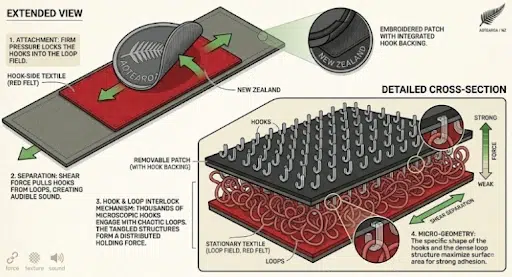
The Hook Side (rough / scratchy) The hook side is the “male” component. It is covered in thousands of tiny, stiff, curved plastic hooks. Typically made from nylon or polyester. In the context of patches, the hook side is glued or stitched to the back of the patch itself. When you run your finger across it, it feels rough and scratchy.
The Loop Side (soft / fuzzy) The loop side is the “female” component. It is woven with thousands of soft, flexible fibre loops: again typically nylon. The loop side attaches to your garment, jacket, bag, hat, or any surface you want your patch to anchor to. When you run your finger across it, it feels soft and fabric-like.
The Engagement When the hook side of the patch is pressed against the loop side on your garment, the hooks catch inside the loops and lock together. The more surface area you press, and the firmer the pressure, the stronger the bond. A standard 80mm × 50mm patch panel develops enough grip to resist several kilograms of pull force which is more than sufficient for any wearable application.
The Release Peeling the patch away at an angle rather than straight off reduces the force required to disengage the hooks from the loops. This is why Velcro patches peel away easily when you want them to, but stay put during normal movement and activity.
A note on grip strength: Quality hook-and-loop fasteners used for military and tactical patches (such as Mil-Spec Velcro® products) are tested to significantly higher engagement and peel strengths than standard consumer hook-and-loop tape. When Embroidery Patch NZ produces custom Velcro patches with hook-and-loop backing, we use commercial-grade nylon hook-and-loop that holds under field conditions.
Types of Velcro Patches Available in NZ
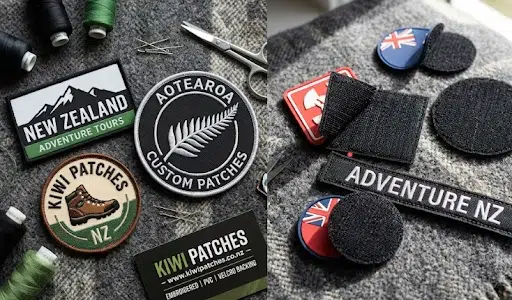
The term “Velcro patch” describes the backing method, not the patch material or manufacturing process. Any patch type can be produced with Velcro backing. Here are the main types available from Embroidery Patch NZ:
1. Embroidered Velcro Patches
The most popular and classic option. Threads are stitched over a woven base fabric to create a raised, textured design. Embroidered Velcro patches have a traditional, premium look that suits uniforms, club badges, and team crests perfectly.
- Best for: Uniform patches, club insignia, military badges, team crests, school patches
- Feel: Textured, raised stitching with a fabric base
- Coverage: Typically 50%–80% thread coverage. Higher coverage = bolder appearance
- Durability: Excellent for everyday wear. Threads can snag if snagged on rough surfaces
- Available at: Custom Embroidered Patches NZ
2. PVC Velcro Patches
PVC (polyvinyl chloride) patches are moulded from coloured rubber-like plastic. They are waterproof, highly durable, and easy to clean. Making them the top choice for outdoor, tactical, and workwear applications. PVC Velcro patches hold their colour and shape through extreme conditions.
- Best for: Tactical gear, outdoor equipment, military morale patches, wet environments, rough use
- Feel: Rubber-like, slightly flexible, smooth or textured surface
- Coverage: Full coverage. Photographic detail is possible. Vibrant flat colours
- Durability: Exceptional waterproof, UV-resistant, abrasion-resistant quality
- Available at: Custom PVC Patches NZ
3. Woven Velcro Patches
Woven patches are manufactured on specialised looms that weave the design directly into the patch fabric rather than stitching it on top. The result is a flat, thin, finely detailed patch that handles small text and intricate line work better than embroidery.
- Best for: Name tapes, fine text, detailed logos, professional uniform patches
- Feel: Flat and smooth with no raised threads
- Coverage: Full-surface coverage. Fine lines and small text read clearly
- Durability: Flat construction means no raised threads to catch or fray
- Available at: Custom Woven Patches NZ
4. Leather Velcro Patches
Genuine or synthetic leather patches with Velcro backing deliver a rugged, premium aesthetic. They age beautifully and suit motorcycle clubs, fashion brands, and premium workwear.
- Best for: Motorcycle jackets, biker clubs, fashion brands, premium uniforms
- Feel: Genuine leather texture. Can be debossed, laser-engraved, or printed
- Durability: Very good. Leather ages naturally with use
- Available at: Custom Leather Patches NZ
5. Chenille Velcro Patches
Chenille patches use cut loops of thick yarn to create a soft, velvety, raised surface. Traditionally used for varsity and letterman jackets, chenille Velcro patches are popular for sports teams and schools.
- Best for: Varsity jackets, sports awards, school letters, team patches
- Feel: Soft, fluffy, thick. The classic “varsity patch” texture
- Durability: Good for display use. Not recommended for heavy outdoor or tactical use
- Available at: Custom Chenille Patches NZ
6. Sublimated Velcro Patches
Sublimated patches use heat and dye to transfer a full-colour digital print directly into the fabric. This allows photographic imagery, gradients, and complex colour work that embroidery cannot replicate.
- Best for: Full-colour designs, photographic logos, gradient artwork, promotional patches
- Feel: Fabric surface, flat and smooth
- Durability: Colours are embedded in the fabric, not printed on the surface
- Available at: Custom Sublimated Patches NZ
Quick Comparison Table: Velcro Patch Types
| Patch Type | Best Use Case | Water Resistance | Detail Level | Typical Price Range |
| Embroidered | Uniforms, club, military | Moderate | Medium | From $0.89 |
| PVC | Tactical, outdoor, workwear | Excellent (waterproof) | High | From $1.65 |
| Woven | Name tapes, fine logos | Moderate | Very High | From $1.25 |
| Leather | Motorcycle, fashion | Good | Medium | From $1.05 |
| Chenille | Sports, schools, varsity | Low | Low-Medium | From $1.15 |
| Sublimated | Photo-realistic, full-colour | Moderate | Very High | From $0.89 |
Prices are base rates per patch for minimum order quantities: See full pricing.
Velcro Patch Backing Options: What is the Difference?
When ordering custom patches in New Zealand, the “backing” refers to what is on the reverse of the patch. How it attaches to your garment or gear. Many buyers confuse the patch type (embroidered, PVC, etc.) with the backing type. They are two separate decisions.
Here is the full rundown of backing options available at Embroidery Patch NZ:
| Backing Type | How It Works | Removable? | Best For |
| Velcro / Hook & Loop | Hook side on patch; loop panel on garment | Yes, easily | Uniforms, tactical, sports, outdoor |
| Iron-On / Heat Seal | Heat-activated glue bonds patch to fabric permanently | No (without effort) | Casual clothing, denim, backpacks |
| Sew-On | Patch stitched directly onto garment | No | Permanent applications, heavy use |
| Peel & Stick / Self-Adhesive | Pressure-sensitive adhesive on patch back | Yes (limited reuse) | Temporary display, smooth surfaces |
| Magnetic Backing | Magnets hold patch to fabric | Yes | Thin fabrics, no-damage applications |
| Pin Backing | Metal pin through patch and fabric | Yes | Lapels, hats, bags |
| Button Loop | Loop allows patch to button onto garment | Yes | Military-style garments |
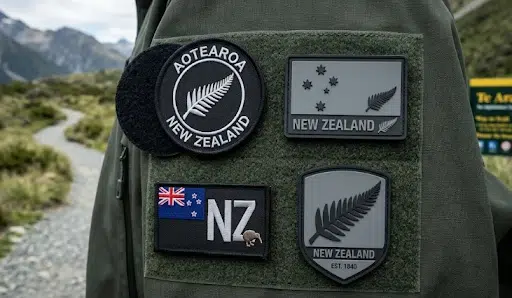
The key advantage of Velcro backing over all other removable options is the combination of grip strength + reusability + large format capability. A 100mm Velcro patch on a tactical vest will survive a full day of running, climbing, and crawling. Whereas a peel-and-stick patch of the same size would detach within the hour.
Velcro vs Iron-On vs Sew-On Patches: Which Is Best for You?
This is the most common question new patch buyers ask. The answer depends entirely on your use case.
When Velcro Patches Are the Right Choice
Choose Velcro backing when:
- You need to swap patches between multiple garments (e.g., the same name tape used on a uniform jacket, a patrol vest, and a training shirt)
- Your garment has pre-attached loop panels. Military uniforms, many tactical vests, outdoor brand jackets, and some sports gear come with loop fields built in
- You work in an environment that requires fast patch changes, rank updates, role changes, event-specific patches
- The patch will be exposed to outdoor conditions: Velcro backing is more water-tolerant than iron-on adhesive, which can fail in repeated wet/dry cycles
- You want to protect your garment from permanent alteration. Velcro leaves no mark when removed
When Iron-On Patches Are the Right Choice
Choose iron-on backing when:
- The patch will permanently live on one garment (denim jackets, jeans, school bags)
- You want the quickest application with no sewing skills required
- The garment surface is cotton, poly-cotton, or denim. The fabrics iron-on adhesive bonds to most reliably
- Price is the primary factor and iron-on backing is the lowest-cost backing option
Read more: How to Iron On a Patch Without Damaging Fabric
When Sew-On Patches Are the Right Choice
Choose sew-on backing when:
- You want the most permanent and strongest attachment. Sewing adds structural bond that neither iron-on adhesive nor Velcro can match for high-stress positions
- The patch is on leather, nylon, thick canvas, or waterproof fabrics that iron-on adhesive will not bond to
- The garment will be washed frequently and at high temperatures
- You are attaching large back patches to motorcycle jackets or cut-off vests where gravity and movement put heavy stress on the patch edges
Head-to-Head Comparison
| Factor | Velcro | Iron-On | Sew-On |
| Removability | Easy, damage-free | Difficult | Permanent |
| Reusability | Thousands of cycles | One-time only | One-time only |
| Strength on garment | Very good | Good (on correct fabric) | Excellent |
| Water resistance | Good | Moderate (adhesive can fail) | Excellent |
| Application ease | No tools needed | Iron required | Sewing required |
| Works on all fabrics | Yes (with loop panel) | Not all fabrics | Yes |
| Best for multiple garments | Yes | No | No |
| Military/tactical suitability | Industry standard | Not standard | Yes |
Bottom line for New Zealand buyers: If your patches need to move between garments or gear, or if you are in a professional, military, or outdoor setting, Velcro backing is the clear winner. For permanent casual fashion applications on a single garment, iron-on or sew-on are simpler choices.
Who Uses Velcro Patches in New Zealand? (Use Cases)
New Zealand has a uniquely diverse patch culture shaped by our military tradition, outdoor adventure industry, sporting culture, and strong club and community identity. Here’s how different groups across Aotearoa use Velcro patches:
Military and Defence
The New Zealand Defence Force (NZDF) Army, Navy, and Air Force use hook-and-loop backed patches for rank insignia, unit patches, name tapes, and operational identification on DPCU and MCCUU uniform systems. Velcro is the NZDF standard because personnel rotate between postings, and rank changes require a simple patch swap rather than reworking sewn insignia. Our custom military patches are produced to match specification requirements for both standard and custom unit insignia.
Police and Emergency Services
NZ Police, Fire and Emergency NZ (FENZ), and St John Ambulance teams use Velcro name patches, rank patches, and identification patches on vests, jackets, and plate carriers. The ability to transfer a name tape between a patrol vest and a high-vis jacket without sewing is practically essential for operational personnel. See our custom police patches for more details.
Security Industry
Private security firms across New Zealand use Velcro-backed name patches, company logo patches, and role identification patches on uniforms. Velcro makes it straightforward to issue standardised patches that swap between company-provided uniform pieces as staff change roles or shifts.
Sports Teams
From club rugby in Hawke’s Bay to netball teams in Dunedin, sports clubs use Velcro patches for team crests, player names, and sponsor logos on training jackets, kit bags, and warm-up gear. A Velcro sports crest on a training jacket can transfer to a supporter’s jacket or be replaced with an updated design at the start of a new season. Explore our custom sports patches options.
Tactical and Airsoft / Milsim Communities
New Zealand’s active milsim (military simulation) and airsoft community is one of the heaviest users of Velcro morale patches and tactical identification patches. Airsoft vests, plate carrier replicas, and tactical packs typically ship with extensive loop-panel coverage. The morale patch culture adds swapping fun, irreverent, or team-identifying patches with other players and is entirely driven by Velcro compatibility. Browse our custom morale patches range.
Outdoor and Adventure Industry
Guiding companies, outdoor education providers, conservation organisations, and adventure tourism operators across New Zealand use Velcro patches to brand staff uniforms and field gear. Staff working across different field sites often carry one patch set that moves between a softshell jacket, a rain jacket, a fleece, and a pack cover. All kept in a single kit bag.
Motorcycle Clubs
Motorcycle clubs from the North Island to the South Island use Velcro-backed patches on riding jackets and cut-off vests alongside or instead of sewn patches. Velcro patches allow club members to display chapter designation patches, event patches, and commemorative patches that change throughout the riding year. Our custom motorcycle patches include Velcro backing options.
Schools, Cadets, and Youth Organisations
Scouts, guides, school kapa haka groups, cadet units, and youth clubs throughout New Zealand use Velcro patches for achievement badges, role identification, and group insignia on uniform shirts, jerseys, and backpacks.
Workwear and Corporate Branding
Businesses operating in construction, utilities, hospitality, and healthcare use Velcro name patches and logo patches on uniform garments. Velcro makes name patch management dramatically simpler when staff turnover is high. A new name patch costs a fraction of a new embroidered uniform.
Best Velcro Patches for Specific Applications
Different applications call for different patch materials. Here is the optimal Velcro patch choice by use:
Best for Military and Tactical: PVC + Hook & Loop
PVC Velcro patches are the gold standard for military, tactical, and law enforcement use in NZ. Reasons:
- Waterproof: will not absorb moisture during wet operations
- Cleanable: mud, blood, and debris wipe off with a damp cloth
- Night-vision friendly versions available: subdued colour schemes that do not reflect IR
- Dimensionally stable: will not shrink, stretch, or fray like embroidered patches under extreme conditions
For standard military uniform insignia where matching existing service dress patches is required, embroidered Velcro patches on a twill base are the traditional choice.
Best for Sports Teams: Embroidered + Hook & Loop
Embroidered Velcro patches strike the right balance of traditional look, durability, and cost for sporting clubs. They survive washing machine cycles well, they hold colour season after season, and they carry the premium “real badge” feel that distinguishes a club crest from a printed iron-on.
Best for Outdoor and Adventure: PVC or Woven + Hook & Loop
For outdoor guides and adventure operators, the choice comes down to branding style. PVC Velcro patches for wet, high-activity roles where the patch is exposed to rain, mud, and constant movement. Woven Velcro patches for a cleaner, more corporate look on softshell uniforms and customer-facing staff kit.
Best for Motorcycle Clubs: Embroidered or Leather + Hook & Loop
Motorcycle clubs typically mix traditional sewn-on back patches with Velcro for smaller chest and sleeve patches that change more frequently. Embroidered Velcro patches maintain the classic patch aesthetic while providing the flexibility to swap event, run, and rally patches throughout the year.
Best for Workwear / Name Patches: Woven + Hook & Loop
Woven Velcro name patches are the industry standard for professional workwear. The flat construction keeps them tidy on collared shirts and formal uniforms. Fine text, including full names, titles, and company names becomes crisp and readable at woven patch scale. Our custom name patches and custom uniform patches pages cover this in detail.
How to Attach a Velcro Patch (Jacket, Hat, Bag & More)
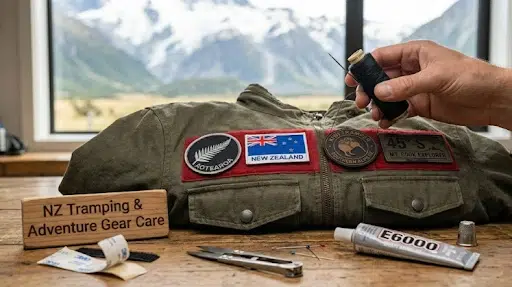
Here is a quick overview. For a full step-by-step guide including cleaning, troubleshooting, and maintenance, read our dedicated article: How to Attach and Care for Your Custom Velcro Patches.
Attaching to a Jacket with an Existing Loop Panel
If your jacket already has a loop panel (common on tactical jackets, military jackets, and many outdoor brand pieces), simply press the patch hook-side down onto the loop panel. Align edges carefully. Overhanging edges create stress points and apply firm, sustained downward pressure for 10–15 seconds across the full patch surface.
Attaching to a Jacket Without a Loop Panel
You need to add a loop panel first. Options include:
- Iron-on loop tape (PSA-backed loop panel): Cut a loop panel slightly larger than your patch. Iron onto the jacket at 160°C for 20–30 seconds on cotton or poly-cotton. Press the patch hook-side onto the bonded loop panel.
- Sew-on loop tape: Stitch a loop panel onto the jacket at your preferred position. More durable than iron-on for jackets that will be washed frequently.
Attaching to a Hat
Most tactical and military-style caps feature a front loop panel for Velcro patches. Position the patch on the panel and press firmly. For hats without a loop panel, sewing a loop panel onto the crown or front panel is the most durable solution. Iron-on loop tape can work on structured caps but may not bond well to curved surfaces.
Attaching to a Bag or Backpack
Many tactical and outdoor packs include MOLLE webbing or loop-faced panels specifically for patches. If your bag does not have a loop surface, self-adhesive loop patches can attach to smooth, clean nylon or canvas surfaces with good short-term grip, though sewing is preferable for permanent attachment.
What Is a Loop Field / Loop Panel?
You will hear the terms loop field, loop panel, Velcro field, and hook-and-loop backing area used interchangeably in the tactical, military, and patch community.
A loop field is simply an area of soft, looped hook-and-loop material. The “female” side that is permanently attached to a garment, vest, pack, helmet, or piece of equipment. It is the dedicated surface that your Velcro patches attach to.
Standard loop field sizes in the NZ context:
| Application | Typical Loop Field Size |
| Cap / hat front panel | 50mm × 80mm (standard morale patch size) |
| Chest patch panel on jacket | 80mm × 50mm or 100mm × 60mm |
| Sleeve ID panel | 50mm × 80mm or custom |
| Tactical vest front panel | 100mm × 80mm or larger |
| Name tape panel | 25mm × 100mm (standard name tape) |
| Large back panel | 200mm × 150mm and up |
When ordering custom Velcro patches, make sure the patch dimensions are no larger than the loop field on your garment. A patch that overhangs the loop field has unsupported edges that catch and peel away.
At Embroidery Patch NZ, we can produce loop panels in any shape and size to match your specific garment. If you are setting up a uniform programme and need both the patches and the loop bases, contact us and we will advise on the right combination.
Custom Velcro Patches NZ: How to Order?
Ordering custom Velcro patches from Embroidery Patch NZ is a straightforward process. Here is exactly what happens:
Step 1: Choose Your Patch Type
Decide on your patch material: embroidered, PVC, woven, leather, chenille, sublimated, or one of our other styles. Not sure which is right for your design? Our team will advise after seeing your artwork.
Step 2: Submit Your Design
Upload your design, logo, sketch, or concept through our quote form. Your design does not need to be polished or production-ready. We have in-house designers who can work up your rough idea into a production-ready file. Free design service is included with every order.
Step 3: Confirm Your Specifications
During the quote process, you will confirm:
- Patch dimensions (width × height in mm or inches)
- Patch type (embroidered, PVC, etc.)
- Backing: Hook & Loop (Velcro) with both the hook and loop included, or hook-side only if you are adding to an existing loop panel
- Quantity (minimum 10 pieces)
- Any special requirements (subdued colours, night-vision-compatible, specific pantone colours)
Step 4: Approve the Free Digital Mockup
Before anything goes to production, we produce a free digital mockup of your patch showing exact colours, dimensions, and layout. You review it and request any changes. We revise until you’re completely satisfied. No charge for revisions.
Step 5: Production and Delivery
Once you approve the mockup, production begins. Standard turnaround for New Zealand orders is 7–10 business days. Urgent production options are available if you need patches faster. We deliver to all regions of New Zealand including Auckland, Wellington, Christchurch, Hamilton, Tauranga, Dunedin, and everywhere in between.
Ready to start? Get a free quote.
Velcro Patch Sizing Guide
Getting the sizing right is critical for Velcro patches. The patch must fit comfortably within the loop panel on your garment without overhanging.
Standard Velcro Patch Sizes
| Size | Dimensions | Common Application |
| Small | 50mm × 50mm | Hat badges, small sleeve patches |
| Standard morale patch | 80mm × 50mm | Cap front panels, chest patches |
| Name tape | 100mm × 25mm | Uniform name patches |
| Medium | 100mm × 80mm | Chest patches, bag patches |
| Large | 150mm × 100mm | Jacket chest panels, back patches |
| Extra large | 200mm × 150mm and above | Full back patches, large vest panels |
Sizing Tips for New Zealand Buyers
- Military uniform patches: NZDF patch panels follow NATO-compatible sizing. Standard chest panel is 80mm × 50mm. Name tapes are 100mm × 25mm.
- Tactical vests: Front panel loop fields vary significantly by vest brand. Measure your loop field and share the dimensions with us at ordering.
- Caps and hats: Most tactical caps use an 80mm × 50mm front panel.
- Custom garments: If you are commissioning a garment with loop panels, we recommend adding a 5mm border beyond the loop field on all sides so the patch never risks overhanging.
For irregularly shaped designs (shield shapes, roundels, flag shapes), we produce custom-shaped patches and can advise on the appropriate loop panel shape to match.
Velcro Patches Pricing in NZ
Velcro patch pricing depends on the patch type, size, complexity, and quantity. Hook-and-loop backing adds a small cost over a standard sew-on backing, but the price difference is marginal given the functionality gained.
Indicative Price Ranges (incl. Velcro backing)
| Patch Type | Min Order | Approx. Price Per Patch |
| Embroidered Velcro patches | 10 pcs | From $1.10–$2.50 |
| PVC Velcro patches | 10 pcs | From $1.90–$3.50 |
| Woven Velcro patches | 10 pcs | From $1.50–$2.80 |
| Leather Velcro patches | 10 pcs | From $1.50–$3.00 |
| Chenille Velcro patches | 10 pcs | From $1.50–$2.80 |
| Sublimated Velcro patches | 10 pcs | From $1.10–$2.50 |
These are indicative starting ranges. Final pricing depends on patch dimensions, design complexity, thread/colour count, and quantity. Volume discounts apply for larger orders. See our full pricing page
What is included in your price:
- Free design / artwork setup
- Free digital mockup before production
- Free revisions until you approve
- Hook side (on patch) + loop side (loop panels for garments) available
- Free shipping within New Zealand
How to Care for and Maintain Velcro Patches
Proper care keeps your Velcro patches performing at full grip strength for years. Quick summary for NZ conditions:
Cleaning the hook side (patch): Remove debris like grass seeds, gorse prickles, Tongariro mud and using a fine-tooth comb or a dedicated Velcro cleaning brush. Run the comb along the hook rows to lift and remove trapped debris. Do this after every outdoor use before storing.
Cleaning the loop side (garment panel): Use a soft-bristle brush in light circular motions to lift the loop pile back to standing height. Matted loops lose grip. A quick brush restores them.
Washing: Velcro patches are generally machine washable at 30°C–40°C. Close the hook panels before washing as open hooks collect lint from other garments. For PVC patches, hand wash or cold machine wash is preferred to prevent PVC surface cracking at high temperatures.
Storage: Store patches with the hook side engaged (pressed onto a loop surface or onto itself) to prevent the hooks from snagging on other items and bending out of shape.
When grip fails: If your Velcro patch loses holding power, debris contamination is the most common cause (80% of cases). Clean both surfaces thoroughly before assuming the Velcro needs replacement. If cleaning does not restore grip, the loop panel on the garment may need replacing as it is a common maintenance item after 2–3 years of heavy use.
Frequently Asked Questions
What are Velcro patches?
Velcro patches are custom-designed patches with embroidered, PVC, woven, or any other material. They have a hook-and-loop fastening system attached to their back. The “hook” side on the patch interlocks with a “loop” panel on your garment, allowing the patch to be attached and removed repeatedly without damage to the fabric. They are also called hook-and-loop patches or Velcro® patches.
Are Velcro patches the same as hook-and-loop patches?
Yes, completely. “Velcro” is a brand name (Velcro® Companies) that has become the generic term for any hook-and-loop fastener, just as “Sellotape” is used generically in NZ for clear tape. When patch suppliers, including Embroidery Patch NZ, list “Velcro backing” or “hook-and-loop backing,” they mean exactly the same thing.
How strong is Velcro patch backing?
Quality commercial-grade nylon hook-and-loop backing develops 4–8 kg of pull resistance per 100cm² of engaged surface for a standard Velcro patch. A typical 80mm × 50mm patch has enough grip to resist several kilograms of direct pull force. In practical wear, this is more than sufficient to hold a patch firmly during running, crawling, or heavy work. Mil-Spec Velcro used on military uniform patches meets even higher engagement strength specifications.
Can Velcro patches be washed?
Yes. Velcro patches are machine-washable. For embroidered Velcro patches, a cold or 30°C gentle cycle is recommended. For PVC Velcro patches, cold water hand-washing or gentle machine wash is preferred. Always close hook-side panels before washing as open hooks collect lint and debris from other items in the load.
How long do Velcro patches last?
Quality nylon hook-and-loop backing handles approximately 10,000 to 20,000 attachment-detachment cycles before grip degrades noticeably. In real-world use, a well-maintained Velcro base on a uniform or outdoor garment typically lasts 3 to 5 years. The patch itself (embroidered, PVC, woven) generally outlasts the Velcro backing.
What is the difference between the hook side and the loop side?
The hook side is the rough, scratchy side covered in tiny plastic hooks. This attaches to the back of your patch. The loop side is the soft, fuzzy side covered in woven fibre loops. This attaches permanently to your garment, bag, or gear. When the hook side of the patch presses into the loop side on the garment, they interlock and hold the patch in place.
Do Velcro patches come with both hook and loop sides?
When you order custom Velcro patches from Embroidery Patch NZ, you can specify if you want Hook side only for the patch back): if your garments already have loop panels sewn in. Full set: hook side on patch plus matching loop panels for your garments. Most first-time buyers ordering for garments without existing loop panels will want full sets.
Can I put Velcro patches on any jacket?
You can put Velcro patches on virtually any jacket, but the jacket must have a loop panel in the right position first. You can add a loop panel yourself using iron-on loop tape (160°C, 20–30 seconds on cotton/poly-cotton) or by sewing a loop panel onto the jacket. For leather, nylon, and waterproof jackets, sewing is the recommended method since iron-on adhesive may not bond reliably to these surfaces.
Are Velcro patches suitable for hats?
Yes. Many tactical, outdoor, and military-style caps come with a dedicated loop panel on the front crown specifically for Velcro patches. Standard morale patch and cap-front Velcro patches measure approximately 80mm × 50mm. If your hat doesn’t have a loop panel, a small loop panel can be sewn onto the crown.
What is a morale patch, and do they use Velcro?
A morale patch is a small custom patch. Typically humorous, motivational, or identity-based. Worn on tactical gear, military uniforms, or casual clothing. The Velcro backing is essential to morale patch culture: it allows wearers to easily swap patches between different pieces of gear and collect patches from others. The entire morale patch subculture is built around Velcro compatibility.
What is a Velcro name patch?
A Velcro name patch, also called a name tape, is a flat woven or embroidered strip bearing an individual’s name, often with rank or role information, attached to a uniform via hook-and-loop backing. In New Zealand, Velcro name patches are standard across NZDF uniforms, police vests, security uniforms, and many corporate workwear programmes. The Velcro backing means a name patch can be transferred between garments or replaced instantly when a staff member changes role or name. See our custom name patches.
How do I remove a Velcro patch without damaging the fabric?
To remove a Velcro patch cleanly, grasp one corner and peel the patch away at a low angle (not straight up). Peeling at an angle progressively disengages the hooks row by row, requiring much less force than pulling straight off. This protects both the patch and the loop panel from damage. There is no adhesive involved, so the garment fabric is not affected.
Can I wash clothes with Velcro patches on them?
Yes, but close the hook panels before washing. Open hook-side Velcro in a washing machine acts like a mechanical claw. It grabs onto towels, clothing, and anything else in the load and causes pilling and damage. Close all hook panels (press them against a loop panel or fold them onto themselves) before putting Velcro-equipped garments in the machine.
What fabrics do Velcro patches NOT work on?
Velcro patches require a loop panel surface to engage with. They do not stick to bare smooth fabric, leather, nylon, waterproof membranes, or any surface without a dedicated loop panel. However, you can add a loop panel to virtually any garment surface using sew-on loop tape. For truly smooth, hard surfaces (helmets, hard shell armour), Velcro loop panels attach via industrial-strength adhesive backing.
Where can I buy Velcro patches in New Zealand?
Embroidery Patch NZ produces custom Velcro patches for delivery across all of New Zealand: Auckland, Wellington, Christchurch, Hamilton, Tauranga, Dunedin, and regional areas. With a minimum order of just 10 patches, free design service, and free digital mockup included, we serve individual buyers, sports clubs, businesses, and large organisations.
Can I order Velcro patches in small quantities in NZ?
Yes. Embroidery Patch NZ has a minimum order of just 10 patches: one of the lowest in New Zealand. This makes custom Velcro patches accessible for small sports clubs, startup brands, community groups, and individuals who need a limited run. Pricing per patch decreases as quantities increase.
Are PVC or embroidered Velcro patches better for outdoor/tactical use?
PVC Velcro patches are better for outdoor and tactical use. They are fully waterproof, easy to clean, resistant to UV degradation, and can be produced in subdued/infrared-invisible colour schemes for military applications. Embroidered Velcro patches are better for applications where a traditional, textile-look badge is preferred, like the formal uniforms, club insignia, ceremonial wear.
Order Velcro Patches from Embroidery Patch NZ Today
Velcro patches are a speciality. They require the right hook-and-loop materials, the right application method to the patch back, and the right expertise to produce patches that hold their backing through wash cycles, field use, and the unique conditions of the New Zealand outdoors.
Here is what sets Embroidery Patch NZ apart:
Free design service with every order: You do not need to be a graphic designer. Send us a rough sketch, a photo, or just a written description. Our designers handle the rest at no charge.
Free digital mockup before production: You see exactly what your patches will look like with correct dimensions, colours, and layout. Before we produce a single patch. No surprises. No do-overs.
Free revisions until you are satisfied: We revise your mockup as many times as needed. Your approval is required before production starts.
Minimum 10-piece orders: We work with small clubs, individual buyers, and large organisations equally. You don’t need a bulk order to get custom professional patches.
All Velcro backing options: Hook-side only, full hook-and-loop sets, custom-sized loop panels, and advice on which backing method suits your garment and use case.
Full range of patch types: Embroidered, PVC, woven, leather, chenille, sublimated are all available with Velcro backing. Mix types within a single order if needed.
Fast NZ delivery: 7–10 business day standard turnaround. Urgent production available. Shipping to all New Zealand regions included free.
20+ years of craftsmanship We have been producing custom patches for New Zealand clubs, businesses, military units, and organisations for over two decades. We know what works.
Ready to get started? Request a free quote and mockup.